Blog / How to Mine an Asteroid
How to Mine an Asteroid, Step by Step: The Engineering and the Business Case
Industries in Space, No. 2 – November 2026
By Galactic Space Industries Team
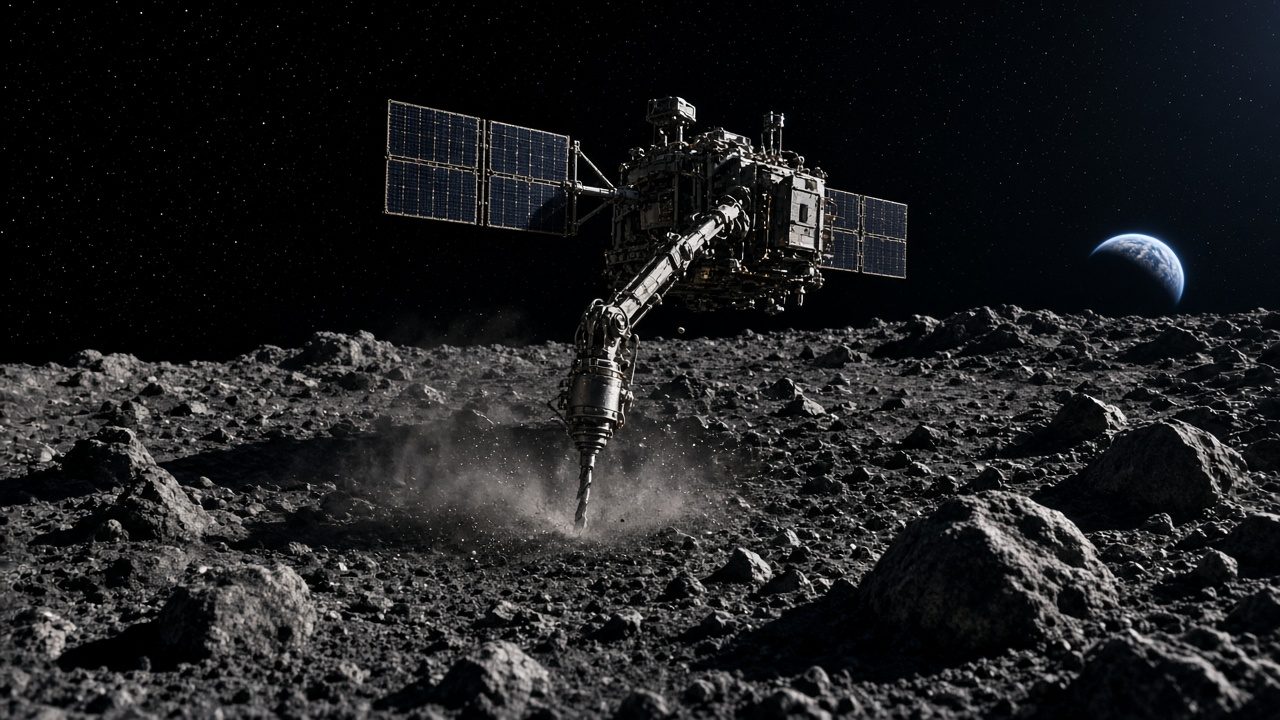
Talk about asteroid mining usually jumps straight to the prize: water for fuel, metal for ships, rare metals worth a fortune. Our earlier post, The Potential of Mining Asteroids, made that case. This deep dive asks the harder question. If you actually set out to mine an asteroid, what would you have to do, in what order, and what would each step cost you?
Here is the job in nine steps, from picking a rock to getting paid. Sources are listed at the end, and estimates and speculation are labelled.
Step 1: Choose the right rock
Few asteroids make good mines. A miner wants a body that is cheap to reach and leave, a composition customers want, and a surface you can work on.
Composition comes first. Carbon-rich asteroids hold water locked inside clay minerals. Metal-rich ones look more like the leftover core of a small planet. Telescopes on Earth can only give a rough guess, so the first real job of any mining venture is prospecting: sending small, cheap spacecraft to look closely before betting on a big one.
Size and spin matter too. JAXA’s Hayabusa2 is now heading for 1998 KY26, an asteroid only about 11 metres across that spins once every five minutes or so. JAXA notes that on a body like that, the outward pull from the spin is stronger than the asteroid’s own gravity. Anything that is not tied down simply drifts away. Fascinating science, poor first mine.
Step 2: Build a spacecraft that can get there and stay
A mining spacecraft does not need to be fast. It does need to be efficient. Most deep-space prospecting designs now use electric propulsion: thrusters that use solar power to fire charged xenon out of the back at very high speed. The push is tiny, but it never stops.
NASA’s Psyche mission shows how that works. It launched in October 2023 carrying about 1,090 kg of xenon. After a gravity assist from Mars on 15 May 2026, it began thrusting almost continuously on 28 September, and NASA says the thrusters will run nearly 90% of the time until it reaches the metal-rich asteroid Psyche in summer 2029. Three years in, it has used only about a third of its xenon.
The commercial version is much smaller. AstroForge’s DeepSpace-2 is a roughly 200 kg spacecraft with a Hall-effect thruster, around 60 kg of xenon and about 5 km/s of “delta-v”, or manoeuvring capability. It is designed to rendezvous with a near-Earth metallic asteroid and photograph it. AstroForge says the mission is self-funded at about $10 million, a small fraction of a traditional science mission.
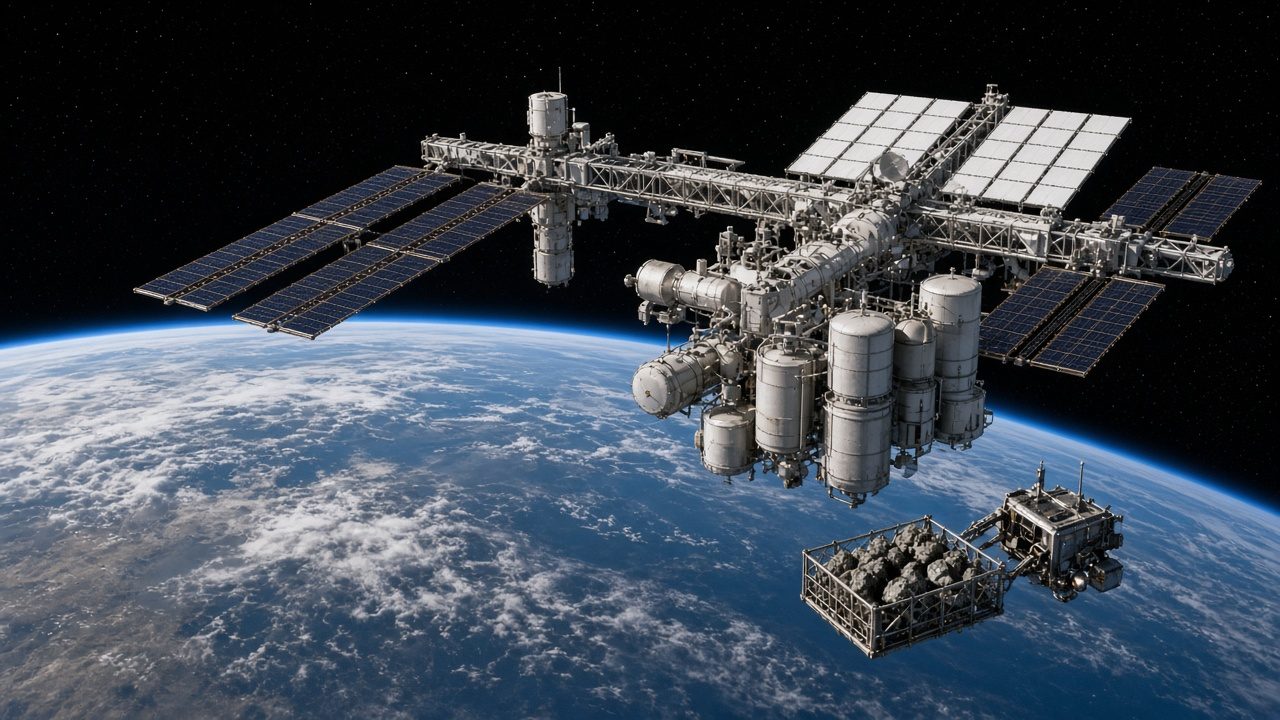
Step 3: Power everything
Every later step runs on electricity: thrusters, drills, heaters, electrolysers and radios. Near Earth’s orbit around the Sun, solar arrays are the obvious answer. Psyche’s two cross-shaped arrays have about 75 square metres of collecting area. DeepSpace-2 produces about 2 kW.
Estimate: a working mine would need far more. Heating rock or melting metal is energy-hungry, so an industrial site would probably need hundreds of kilowatts or more: huge arrays, mirrors that concentrate sunlight, or eventually nuclear power. None has been built for mining yet.
Step 4: Arrive and hold on
Landing on an asteroid is less like landing on the Moon and more like docking with something that might fall apart. When OSIRIS-REx touched the asteroid Bennu in October 2020, its sampling arm met almost no resistance. NASA later found the spacecraft would have sunk into the surface had it not fired its thrusters to back away. Scientists compared Bennu’s loose surface to a children’s ball pit. A gentle tap left a crater about 8 metres wide.
That changes the robotics problem. Wheels and drills that push against the ground do not work well when there is almost no gravity holding you down. Proposed answers include anchors and harpoons, bags around a small loose body, and gripping feet that hold onto boulders. China’s Tianwen-2, which reached the near-Earth asteroid Kamoʻoalewa in July 2026, is due to try sampling using touch-and-go and anchor-and-attach methods.
It also has to be autonomous. Radio signals can take minutes to reach a distant asteroid, so nobody can steer a drill by joystick. The robots must handle problems themselves, which is why AI and onboard computing sit at the centre of modern designs.
Step 5: Dig
So far, humanity’s entire asteroid haul fits in a cupped hand. Hayabusa2 returned about 5.4 grams from Ryugu in 2020. OSIRIS-REx delivered 121.6 grams from Bennu in 2023, more than twice its target. The Bennu material contains carbon and water-bearing clay minerals, which shows the water is really there.
Speculative: moving from grams to tonnes would need different machines. Ideas include scoops or bucket wheels that work inside an enclosure so dust cannot escape, optical mining that uses focused sunlight to bake material off the surface, and, for small rocks, simply capturing the whole asteroid in a bag. All of them are still at the concept or laboratory stage.
Step 6: Process it where you are
Raw rock is heavy and mostly worthless. The value is in what you extract, so processing should happen at or near the asteroid.
Water is the simplest product. Heat water-bearing rock, catch the vapour, then split the water with electricity into hydrogen and oxygen, which are rocket propellant. NASA studies of lunar water lay out exactly this chain: extract, purify, electrolyse, then liquefy and store the gases. Making oxygen away from Earth has been shown to work, but only on a tiny scale. NASA’s MOXIE experiment on the Perseverance rover made 122 grams of oxygen from the Martian air between 2021 and 2023.
Metals are much harder. Refining on Earth relies on gravity to separate molten metal from slag, and very little refining has ever been tried in space. AstroForge flew a small refinery demonstration, Brokkr-1, in April 2023, but communication problems meant it could not run the test. That is an honest measure of where in-space processing stands.
Step 7: Deliver to a customer
The best customer for asteroid products is already in space. Propellant sold at a depot in orbit saves a customer from launching it, and that saving is what sets the price. At SpaceX’s published price of $74 million for a Falcon 9 launch, and a NASA analysis putting Falcon 9 at roughly $2,720 per kilogram to low Earth orbit, a kilogram already in space is worth something. Higher orbits and deep space are worth more.
Cheaper launches cut both ways. SpaceX’s fully reusable Starship, still in flight testing in late 2026, could make mining hardware cheaper to launch, but also make Earth-launched water and metal cheaper, shrinking the miner’s advantage. Estimate: early buyers are most likely to be stations, tugs and deep-space missions, the kind of traffic described in our Hotels in Space article. Precious metals shipped to Earth would probably come later, in small amounts.
Step 8: Make sure you are allowed to sell it
Under Article II of the 1967 Outer Space Treaty, no nation can claim a celestial body. What a company may do with material it removes is a separate question, and several countries have answered it.
- United States, 2015: the Commercial Space Launch Competitiveness Act, signed on 25 November 2015, says a US citizen who recovers an asteroid or space resource is entitled to “possess, own, transport, use, and sell” it, while disclaiming any US sovereignty over celestial bodies.
- Luxembourg, 2017: its law of 20 July 2017 opens with “Space resources are capable of being owned” and requires a ministerial licence for every mission. The first licence went to ispace EUROPE in November 2024 for lunar regolith collection.
- Artemis Accords: these non-binding principles, which include space resource extraction, had 78 signatory countries as of late October 2026, with Vietnam the latest.
There is a precedent for a sale, too. In December 2020 NASA agreed to buy small amounts of lunar regolith from four companies, one of them for just $1, to establish that resources collected in space can be bought and sold. Disputes over who may mine which rock have not yet been tested.
Step 9: Pay for it all
This is where the first wave of companies came unstuck. Planetary Resources was acquired by the blockchain firm ConsenSys in October 2018, and Deep Space Industries was bought by Bradford Space in January 2019, which moved its focus to propulsion. Neither reached an asteroid.
Government missions show the scale of the bill. The Planetary Society puts the lifetime cost of OSIRIS-REx at $1.02 billion. Estimate: divided by the 121.6 grams it returned, that is roughly $8 million per gram. That is a science mission, not a mine, but it shows how far costs must fall.
The new approach is to build small, cheap spacecraft and fly them often. AstroForge lost contact with its first deep-space probe, Odin, soon after launch in February 2025. Its $10 million DeepSpace-2 is due to ride with Intuitive Machines’ IM-3 lunar mission, which NASA now lists for early 2027. AstroForge’s own mission page also now says “launching 2027”. If it works, AstroForge says it will be the first commercial spacecraft to rendezvous with an asteroid.
A realistic timeline
The scheduled missions give the next few years a fairly clear shape:
- 2027: Tianwen-2 aims to collect its Kamoʻoalewa sample and set off for home. AstroForge’s DeepSpace-2 is set to launch.
- 2029: Psyche arrives at its metal-rich asteroid and starts about two years of mapping.
- 2031: Hayabusa2 reaches the tiny, fast-spinning 1998 KY26.
Speculative: after that, a plausible path is a first small water-extraction demonstration at a near-Earth asteroid in the 2030s, followed by propellant sold to customers in orbit if the demonstrations work. Metal refining and building ships from asteroid material are likely to come later. Each step depends on the one before it, and every date beyond the funded missions above is a guess.
The bottom line
Mining an asteroid is not one breakthrough. It is nine hard steps that must all work together. The first few are real: we can find, reach, touch and sample asteroids, and electric propulsion can carry a spacecraft across the inner solar system. The steps that make money, digging at scale, processing in space and selling in orbit, have barely been tried. Closing that gap is the engineering story of the next decade. For the wider picture of how this fits into the off-world economy, see The New Space Industry.
Further reading
- JAXA/ISAS – Hayabusa2 and its extended mission to 1998 KY26
- JAXA – Hayabusa2 flyby of asteroid Torifune (July 2026)
- ISAS – Ryugu sample about 5.4 grams (Japanese)
- NASA – Psyche heads toward the asteroid belt (Oct 2026)
- AstroForge – DeepSpace-2 mission
- Aerospace America – AstroForge preps for second attempt at reaching an asteroid
- AstroForge – Update on Missions 1 and 2 (Brokkr-1)
- NASA – Intuitive Machines IM-3 (early 2027)
- NASA – Bennu’s surface is like a plastic ball pit
- NASA – OSIRIS-REx bulk sample mass (121.6 g)
- NASA – Bennu sample contains carbon and water
- The Planetary Society – Cost of OSIRIS-REx
- SpaceNews – Tianwen-2 arrives at asteroid Kamoʻoalewa
- NASA NTRS – Producing propellant from lunar water
- NASA – MOXIE completes its Mars mission
- SpaceX – Capabilities and services (Falcon 9 pricing)
- NASA NTRS – The recent large reduction in space launch cost
- UNOOSA – The Outer Space Treaty
- US Public Law 114-90 – Commercial Space Launch Competitiveness Act (Title IV)
- Luxembourg Space Agency – Law of 20 July 2017
- Luxembourg – Space resources authorisations register
- NASA – Vietnam signs the Artemis Accords
- NASA – Companies selected to collect lunar resources (Dec 2020)
- SpaceNews – ConsenSys acquires Planetary Resources
- SpaceNews – Deep Space Industries acquired by Bradford Space